The Spanish Inquisition arrived in Seville in 1480 with a mission that went far beyond persecution. It literally redesigned the city—moving neighborhoods, erasing streets, and rewriting the geography of power. Understanding what happened here is understanding why modern Seville looks, feels, and operates the way it does—and it's the story at the heart of our Seville private tour.
The Moment That Changed Everything
In 1480, the Spanish crown made a decision: Seville needed to be "purified."
The city at that moment was a multicultural hub. Jews, Muslims, and Christians lived in close proximity—not always peacefully, but coexisting within a functioning urban system. Merchants from across the Mediterranean traded there. The River Guadalquivir brought ships loaded with wealth. Seville was cosmopolitan.
The Spanish Inquisition changed that in a single decade.
What happened wasn't just violence. It was systematic urban redesign. The Inquisition didn't just arrest people. They reorganized the city's physical space. They eliminated entire neighborhoods as they had existed. They created new boundaries. They literally rebuilt Seville to reflect Christian supremacy.
This is why understanding The Spanish Inquisition matters to tourism today: because the Seville you visit is, in many ways, the Seville that the Inquisition created.
Most visitors see Seville. Few understand it. A guide who tells the story tourists never hear.
Reserve Your Private Walking Tour →
How the Inquisition Restructured the City
The most visible impact was on the Quarter Santa Cruz (former Jewish quarter).
Before the Inquisition, this wasn't a separate quarter. It was an integrated neighborhood where Jews lived and worked alongside other populations. But starting in 1480, the Inquisition began a deliberate process of isolation and control:
They narrowed the streets. Wide streets allowed people to move freely. Narrow streets could be monitored.
They created dead ends. These trapped populations and made escape impossible during raids.
They installed the Church of San Salvador at the center. This wasn't about religion—it was about dominance. By placing a church at the heart of what had been a Jewish quarter, they were literally erasing the previous religious geography.
They rerouted commerce. The Food Market of la Encarnación and other commercial activities were moved away from the Jewish quarter, strangling the economy.
The result: a neighborhood that looks charming to modern tourists but was deliberately designed as a cage.
The narrow streets that tourists photograph? They were built to control a trapped population. The hidden courtyards that seem quaint? They were designed so the Inquisition could conduct interrogations and executions out of public view.
The Political Machinery of the Inquisition
The Spanish Inquisition wasn't a religious organization in the way we understand religion. It was a political apparatus designed to consolidate royal power.
The monarchy had a problem: they owed enormous debts to Jewish merchants and bankers. The Inquisition solved this problem by:
- Arresting wealthy Jews and seizing their property
- Forcing conversions (so Jews couldn't be expelled while still being taxed)
- Creating a climate of fear that froze economic activity
- Eliminating a rival power structure (Jewish merchants had leverage; converted Jews under suspicion had none)
The wealth that the Inquisition seized in Seville was astronomical. Some estimates suggest that the confiscations in Seville alone funded Spanish colonial expansion. The money stolen from Seville's Jewish community paid for ships and soldiers that conquered the Americas.
This is the hidden history of Seville: its wealth partly comes from Inquisitorial theft.
The Geography of Fear: How Seville Was Reorganized
When you walk through modern Seville, you're walking through a city designed by fear.
The Puerta de Jerez was redesigned to function as a checkpoint. People entering the city could be monitored. This wasn't about security from external threats—it was about controlling the population inside the city.
The Casa de la Moneda (where coins were made) was moved to a fortress-like structure under heavy guard. Why? Because if you can control the money supply, you control the city. The Inquisition understood this and positioned the mint where it could be defended.
The Plaza del Cabildo and its Town hall were positioned to dominate the Quarter Santa Cruz. The government literally looked down into the Jewish quarter. This wasn't accidental urban planning—it was deliberate surveillance architecture.
The Triana Quarter, across the River Guadalquivir, became a dumping ground for people the city didn't want. Roma, Muslims, Jews who had converted under pressure—they all ended up there. The river became a physical boundary enforcing social separation.
The Royal Palace Alcazar and its gardens? Built to demonstrate wealth and power. To show that the monarchy was supreme. To announce that Christian order had been imposed on what had been a multicultural space.
What the Inquisition Actually Did
The popular image of The Spanish Inquisition is torture and burnings. The reality was more insidious.
Most of the damage happened through:
- Confiscation: Seizing property, leaving families destitute
- Forced conversion: People staying in the city had to become Christian, publicly, regardless of private belief
- Constant surveillance: Informants everywhere, anyone could be denounced
- Destruction of records: Erasing the documentation of Jewish life, making it seem like they'd never been there
- Segregation: Creating physical barriers that made coexistence impossible
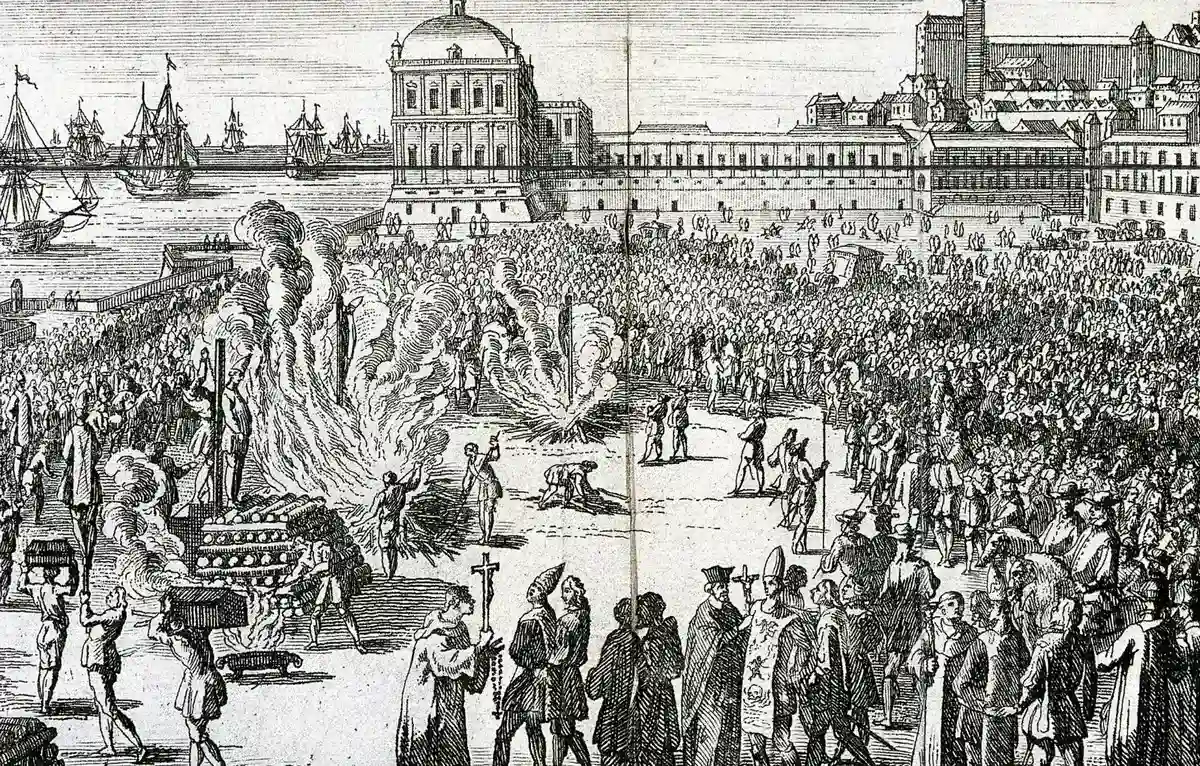
In Seville specifically, the Inquisition conducted massive autos-da-fé (public trials/executions) in the Plaza del Salvador and the Giralda tower plaza. Thousands watched. The events were designed as public spectacle meant to terrify the population into compliance.
The reason you can still see the layout of the Quarter Santa Cruz today is because the Inquisition's urban redesign was so thorough. They literally rewrote the city's geography, and those changes are still embedded in modern streets.
The Paradox: Beautiful Architecture Built on Erasure
This is where it gets uncomfortable for modern tourism:
The beautiful Cathedral of Seville and Giralda tower that tourists admire were built partly to celebrate Christian victory over a non-Christian city. The architectural magnificence was deliberately meant to announce dominance.
The charming streets of the Quarter Santa Cruz were designed to trap people. The courtyards that photographers love exist because they allowed surveillance and control.
The Metropol Parasol, sitting above the Antiquarium (roman ruins): inside, represents the modern obsession with building on top of history rather than confronting it directly. We build new structures and pretend the old ones aren't there.
Seville's beauty is real. But understanding where that beauty comes from—understanding that it was built on the erasure of an entire population—that's what actually makes the city matter.
Why the Inquisition Succeeded in Seville (And What That Reveals)
The Spanish Inquisition could have failed. In some cities, populations resisted. In Seville, they didn't—not effectively.
Why? Because the Inquisition was brilliant at dividing populations:
- Converting some Jews meant that not all Jews stood together
- Marginalized Muslims to Triana Quarter, making them politically irrelevant
- Elevated Christian merchants who benefited from confiscations, creating an invested class
- Flooded the city with informants so nobody could trust anyone
- Made the consequences of resistance public and terrifying
The Inquisition in Seville succeeded because the city's population was fractured and the costs of resistance were deadly.
This historical lesson still echoes: divided populations can't resist concentrated power. And the architecture of Seville—designed to divide and control—is still dividing populations today. The River Guadalquivir still separates the wealthy north from working-class Triana. The Quarter Santa Cruz is still a maze designed to confuse outsiders. The city is still structured around surveillance and control.
The Unconverted: The Jews Who Stayed Secret
Not everyone left or converted. Some Jews in Seville hid their identity. They performed Christianity publicly while maintaining Jewish practice privately.
This created a new city: a hidden one. Secret synagogues in basements. Hidden prayer gatherings. Coded language. A double life.
This hidden layer of Seville—the unconverted Jews living in plain sight—is the most fascinating and least documented part of Inquisition history. They lived in the same neighborhoods. They worked the same jobs. But they had an entire secret culture underneath.
Some historians believe that this hidden layer influenced Seville's culture in ways we don't fully understand. The intensity of Triana Quarter's flamenco, for instance—could some of that emerge from displaced populations living with constant fear and hidden identity?
We don't have answers. But the questions alone show how deep The Spanish Inquisition impact went.
Not a tour package. Access.
Plan Your Two Half-Day Tour
The Collective Amnesia: Why Seville Forgot
Here's what's remarkable: after the initial violence and confiscations, Seville largely stopped talking about it.
The city moved on. The confiscated property was integrated into the economy. The reorganized neighborhoods became "normal." The Inquisition's victims were forgotten. Within a generation, people acted as if the Jewish population had never existed.
This is why The Spanish Inquisition matters to understanding modern Seville: because the city's refusal to acknowledge what happened is as important as what happened.
The Quarter Santa Cruz exists as a tourist destination partly because we've erased its actual history. It's beautiful and charming because we've forgotten it was designed to oppress. The Giralda tower is magnificent because we've stopped asking what it was built to celebrate. The Cathedral of Seville inspires awe because we rarely mention it was partly built with confiscated wealth.
Seville's modernity—its ability to move on—is built on strategic forgetting.
Understanding the Inquisition Changes How You See the City
If you visit Seville knowing nothing about The Spanish Inquisition, you see a beautiful medieval city with historic architecture.
If you understand The Spanish Inquisition, you see something different:
- The narrow streets of Santa Cruz as cages
- The Giralda tower as a monument to conquest
- The River Guadalquivir as a social boundary
- The Plaza del Cabildo as a panopticon
- The Food Market of la Encarnación as a tool of economic strangulation
- The entire city as a case study in how power reorganizes geography
You stop seeing pretty streets and start seeing the decisions that shaped them. You understand that tourism in Seville is partly built on aesthetic appreciation of infrastructure designed to oppress.
This doesn't make Seville less worth visiting. It makes it more worth understanding.
The Tours That Actually Explain This
Most guides in Seville deliver facts: dates, architectural details, famous names.
A few guides understand that facts without context are just trivia. The Spanish Inquisition isn't just something that happened—it's the foundational event that shaped everything about how Seville is organized.
The best tours in Seville don't just show you the landmarks. They explain why those landmarks exist, what they commemorate, what they erased, and what that erasure means for how we understand the city today.
Our private tour, The Road Less Traveled, specializes in exactly this: going beyond the obvious narrative and understanding the darker histories embedded in the city's geography and architecture.
Most visitors leave Seville having seen beautiful buildings. The right guide helps you understand that those buildings exist within a specific history—a history of power, erasure, and control that never fully ended
This isn't a typical walking tour. It's historical education embedded in your experience.
Most tourists walk away from Seville having photographed landmarks. You'll walk away understanding why those landmarks exist—what they commemorate, what they erased, and what that erasure means for how we understand power, geography, and control.
What Changes When You Actually Understand
Standing in the Church of San Salvador, surrounded by medieval architecture, knowing that it was placed there to symbolically dominate a Jewish neighborhood—that changes everything about what you're looking at.
Walking the streets of the Quarter Santa Cruz, understanding they were designed as a cage, makes you see the space completely differently.
Seeing the River Guadalquivir not as scenery but as a boundary that separated communities for centuries changes how you understand Seville's social geography.
Realizing that the Cathedral of Seville and Giralda tower were partly built with confiscated wealth from people expelled or forced to hide their identity—that context matters.
This is what separates actually understanding a city from just photographing its landmarks.
A Private Tour of Seville Beyond the Tourist Narrative
If you want to visit Seville and actually understand what happened there—if you want to know why the city looks the way it does, why certain neighborhoods are organized as they are, what The Spanish Inquisition changed and what it reveals about power and architecture—you need someone who understands the deeper history.
There are guides who specialize in this. Who can walk you through the city and explain not just what you're seeing, but why it exists, what it means, and what it reveals about how power actually works.
Our two half-day private tour of Seville (4+4 hours) is designed exactly for this: for people who want to see beyond the obvious and understand the real history of the city.
Most tourists see Seville once and leave. The right tour helps you understand it deeply enough that you'll think about it for years.
Ready to Understand What You're Actually Looking At?
If you've read this far, you understand something most tourists never grasp: Seville's beauty is inseparable from its darker history. You can't truly see the city without understanding The Spanish Inquisition and what it did to reshape the urban landscape.
This isn't a typical walking tour. It's a history lesson that changes how you understand everything you see.
This isn't a tour package. It's access.
Access to guides who actually understand why the city looks the way it does. To the stories that explain the architecture. To the comprehension that transforms pretty streets into meaningful history. You can walk through Seville on your own and see beautiful buildings. Or you can walk with someone who can explain what those buildings mean.
Book Your Seville Private Tour: Understanding Over Sightseeing
The deeper history of Seville is waiting. Are you ready to understand it?